
Welcome to the Eat, Shop, Play, Love blog. This is a writing experiment that aims to lend a voice to the millions of Asians around the world who have left their native countries to live their lives in a different place, for whatever the reasons may be. Read the authors' profiles here.
Showing posts with label play. Show all posts

Monday, October 31, 2011

Lady J on play: The day I felt like Charlie

I guess the character Charlie in Roald Dahl’s famous children’s novel titled ‘Charlie and the Chcolate Factory’ needs little introduction. The novel centers around a poor boy named Charlie Bucket whose life changed when he scored a golden ticket and took a tour through the greatest chocolate factory in the world, owned by the eccentric Willy Wonka.
As I read the book and subsequently watched the movie, I kept imagining what it would feel like to actually visit a chocolate factory. My dream came true the day we paid a visit to the famous Maison Cailler chocolate factory in Broc. I mean, we are living in Switzerland which has the highest per capita rate of chocolate consumption worldwide (approximately 12 kg per capita per annum) and what better way to immerse in the Swiss chocolate culture than paying homage to one of the very first chocolate brands established in Switzerland.
Chocolate factories must be a dime a dozen here in Switzerland. I recalled being blown away by the selection and brands of chocolate that one could get here when we first arrived in Geneva. One wouldn’t know where to start in the supermarket when picking out his chocolate. Friends who lived here for over 15 years told us specifically that the one brand of chocolate that most Swiss grew up with is Cailler.
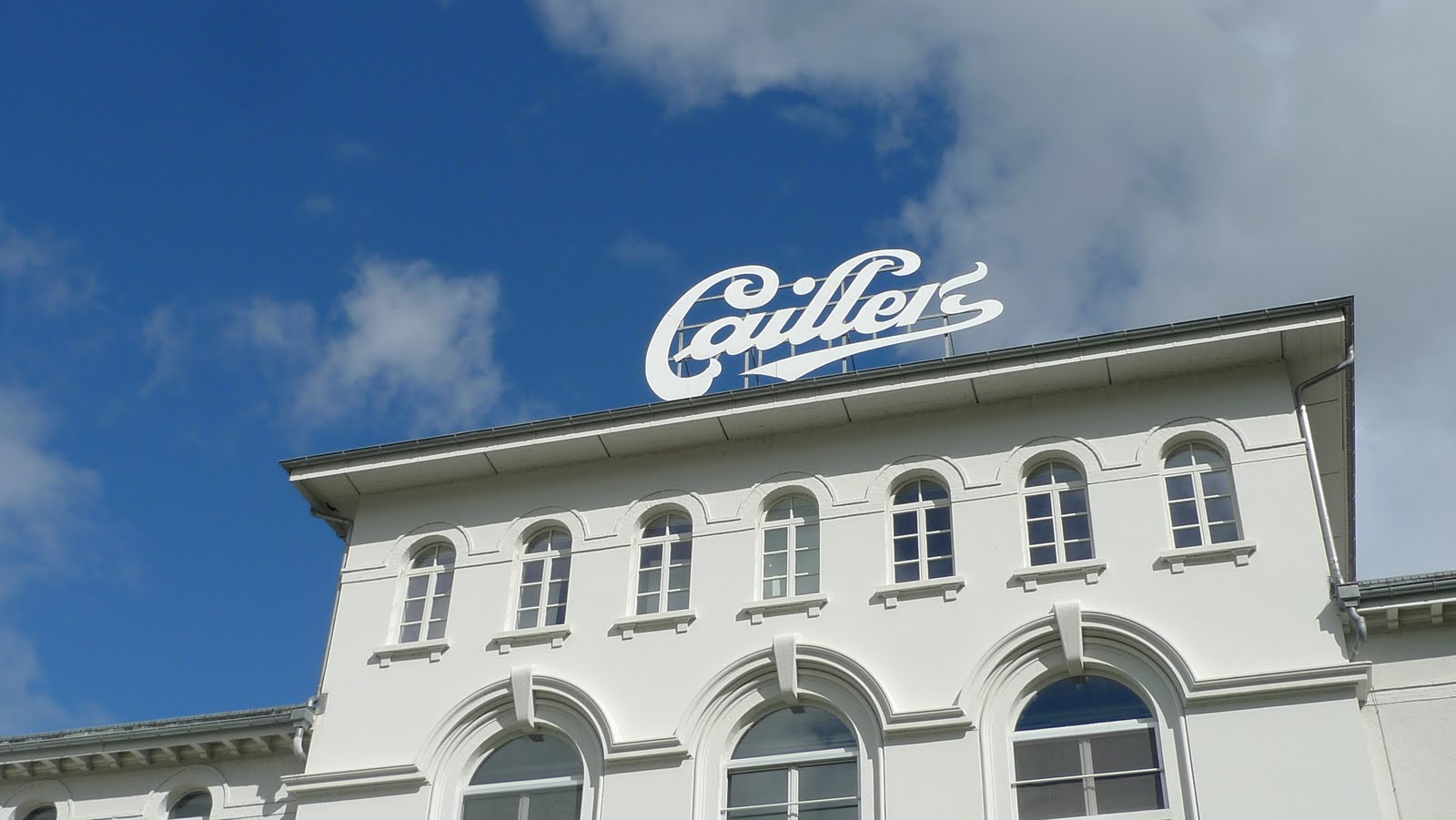
The infamous Maison Cailler chocolate factory

A quick search online and I realised that the Maison Cailler chocolate factory is located in Broc and a road-trip which took us about 2 hours from Geneva to Broc was planned. The factory was a bit out of the heart of town, but thank goodness for our GPS and some strategically-placed signs, we were eventually led to the Maison. We also noticed that the moment we started walking towards the factory, the aroma and fragrance of chocolate filled the air. I felt really excited as the doors to the factory opened.
The Masion Cailler chocolate factory dates back to 1897 when Alexandre Cailler, who was bicycling through the area, discovered the perfect spot to open his new chocolate factory. Milk is one of the most important ingredients in producing fine chocolate, so when he saw so many lush pastures dotted by plump cows, Mr. Cailler decided that Broc would be the ideal place to set up shop.
We went on the 45-minute interactive guided tour that began with a video on the history of chocolate. We also learnt how the Swiss learned to further process the cocoa bean by combining it with rich cream, thereby creating the wonderful chocolate that we know today.
Just like Charlie, I was mesmerised by the extensiveness of the factory and as I walked into the olfactory room, my hands dug straight into the bag of roasted cocoa beans to take in a waft of the fresh smells. I hopped from one bag to the next, waiting to see what I will be uncovering next. My attention was immediately shifted when I spied the massive production line where fresh chocolate was waiting to be packaged. I grabbed one of the freshly packaged chocolate and stuffed it in my mouth... Mmmm heaven! That’s what having a good piece of fresh chocolate does to me; my taste buds were treated to the fabulous flavours of the best cocoa and other delicious ingredients all tucked into that little bar.

I want me some of those chocolate, now!
Before the visit ended, we were whisked into a tasting room where large tables were set with trays laden with samples of every imaginable kind of chocolate cut into small tasting sizes. Needless to say, I got to nibble on these complimentary delightful chocolate to my heart’s content.
All that wonderful pieces of chocolate that we could eat.. Heaven!

By the time we left the factory, I felt a little guilty for stuffing my face silly with all that chocolate but hey, I guess for that brief moment, I knew how Augustus Gloop felt. Thankfully, I did not fall into some chocolate lake and get sucked away.
I know.. This definitely would not be the prettiest sight to be photographed in.

This visit to Masion Cailler chocolate factory has certainly taught me a thing or two. I will never look at a bar of Swiss chocolate the same way again and whenever I take a bite of that bar of Cailler chocolate, I would close my eyes and magically whisk myself back to that factory to relieve that chocolate experience.

[Some images taken off the web]

Saturday, October 29, 2011

Una Ragazza on Play: Occupy October

October. My favorite month of the year. The weather cools down, the fall colors break out. We're that much closer to Thanksgiving (read: turkey and pie).

This year, so much has happened and the month is not even over as I type. The following images captured the essence of October 2011 in my little part of the world.


In early October, everyone's favorite tech genius and entrepreneur lost his battle to pancreatic neuroendocrine tumor. The only appropriate way to capture this tribute outside my neighborhood Apple store was with the iPhone 4S.


During a visit to Zuccotti Park in mid October, I met a range of talented individuals.


This guy had a perpetual grin on his face as he pivoted around to ensure protesters and gawkers alike had a fair chance to read his message.


This guy painted all the flaps of the tiny box he was sitting in.


His latest sign read, "Let's show China how it's done."


The guy in the foreground slept through it all -- quite an accomplishment, considering the musicians on the steps were playing at a volume so loud that the nearby crowd couldn't hear each other speak.


This bicycle picture was taken for Un Ragazzo. It seemed like everyone at Zuccotti Park had a different goal and message.


Bring a t-shirt or apron and get a complimentary silkscreening.


On Halloween weekend, as the snow began to fall, folks at Zuccotti Park hunkered down beside Double Check, the bronze businessman sitting on a nearby bench.


Meanwhile, back uptown, snow accumulated nicely on the brownstone roofs, as smoke spewed from some chimneys.


A pumpkin looked out the momofuku window at the sleet that soon turned to snow.


At the "neighborhood graveyard," the black crow got a new coat of white.


"Good weather" was clearly not in sight at the community garden in the 'hood.


A kids' halloween party snowed in.


Pumpkins on steps in hiding.

With two more days to go, will October bring another interesting twist? Don't hold your breath; Halloween Monday is yet to come.

(Some pictures taken from the Internet)


Sunday, August 7, 2011

Little Pixy Boots: T'is the Season to be Plucking

Whoa, I apologise for being MIA for a while. It's been a busy few months for me and I've been flying back and forth Singapore, UK and Norway. Anyway, this post is about *play* so I decided to focus on the popular berry-picking season in summery Norway!

Berry berry, quite contrary

Late July til mid-August is the best time to pluck berries in Norway, although if you travel up north you find that the berry-plucking season extends to as late as September. Recently Viking Man and I had great fun going up a mountain to try our luck with blueberry plucking.

A lot of Norwegians take blueberry plucking very seriously. Others take it as a nice leisure activity with the reward of juicy berries with rich Vitamin C and antioxidants at the end of the day. Many also take it as a excuse to exercise (or å trene) in fresh outdoor air, give their legs a good stretch or go out with someone they fancy in a group date (this applies to many young adults).


Usually the best places to pick blueberries is higher ground on a mountain forest (fjellskog in Norwegian). Usually the best places are low mountain plateaus around 800 - 1200 metres above sea level, which provide nice gradual slopes which are very conducive for blueberries to grow. One new thing I learnt yesterday is that blueberries (blåbær) grow in the same kind of terrain with other berry types like tyttebær (mountain cranberries) and markjordbær (wild strawberries). One of my favourite native Norwegian flowers grows in abundance in this mountain terrain too, but I don't know its name. Would be good if someone lets me know :) I had it in my wedding bouquet.


To our disappointment, we were a little late for blueberry plucking - either that or we chose a mountain too popular for plucking. Most of the blueberries were gone and the sight of blue-stained leaves and no berries isn't pretty. A lot of Norwegians nowadays like Viking Man, prefer to use a berry plucking device ("berry picker") that allows one to pluck berries very quickly but berries come along with leaves, branches and crushed berries, which I dislike. Maybe I'm old-fashioned and picky, but I like to hand-pick my berries despite the slower pace and juice-stained fingers at the end of the day. The berries I get are cleaner and I derive more enjoyment from it. Using a "machine" reduces the tactile and visual enjoyment, I feel.

Anyway, while looking for a picture of the berry picker, I found a nice blog on berry picking in Sweden, where apparently not all the blueberries are plucked yet! Lucky her. I'm envious! There's a picture of the berry picking devise on her blog.

Since there were few blueberries for us to pick, we picked more of tyttebær (mountain cranberries) instead. They ripen about 3 weeks after blueberries so we came just as they are ripening. Some of them are not that red yet because we were picking on the east side of the mountain where the cranberry bushes get less sun.

A lot of the tyttebær were red on one side and white on the other. I find it amazing that the fruits require sunlight to ripen. Look at the pretty little cranberry flowers too! Sometimes when we chance upon a patch where pluckers have not been too, I get a little obsessed with getting as many as possible.

Tips on berry picking:

1. Wear dark old clothing - long track suits are suitable, as well as cotton yoga tights with a dark jacket. Wearing a dark t-shirt and bringing a long-sleeved jacket is good because it gets cold on top of the mountain.

2. Wear rubber boots or summer mountain climbing boots that support the ankles. Berries tend to stain a lot so it would help not to wear fashionable white canvas shoes! Most paths are rocky and muddy, so thicker soles and waterproof material are better protection for the feet.

3. Bring a backpack or sling bag. Keep your arms free from carrying anything. If you bring a bucket and berry pickers, then make sure they are brightly coloured so that you don't "lose" them while you wander off to better pastures.

4. Mosquito repellent - helps to keep the mozzies away!

5. Sunscreen lotion - helps prevent sunburn in case there is strong sunlight.

6. Sunglasses - they come in handy while driving to the mountain.

7. Many snacks! Bananas, "kvikklunsj" (chocolate bars for energy), apples, yogurt etc. In our case, we also brought yummy dried bean curd from Taiwan ("Naughty Spicy Dried Bean Curd").

Picture by Katie the hungry traveler http://katie-thehungrytraveler.blogspot.com/

8. Plastic bags! Clean plastic bags are useful when you are picking berries - sling them over your lower arm or wrist while putting them into the bag (if you are hand-picking), then transfer the berries to the bucket. It's much easier than carrying the bucket around. Plastic bags are also useful as trash bags, because where are you going to discard all those banana skins and plastic wraps? Not on the Norwegian mountains of course. Actually, I must confess that Viking Man did discard banana skins in a hidden corner of a blueberry bush, claiming that nature will take its course to decompose it. He was careful not to fling it anywhere in sight though. I didn't prepare any plastic bags beforehand, so I had to use my tissue packet to stuff all our trash in it.

But as a tool, plastic bags are useful, according to my two meagre years of cherry plucking experience!

9. Gloves - optional. I personally don't care if my fingers get (blood)stained or not, but blueberries can leave quite a purplish stain on your hands. This year I brought a pair, but found them to be more of a hindrance than help. I didn't use them and they kept dropping out of my jacket pockets. I wouldn't bring them the next time.

10. Waist pouch - optional. Bring this if you didn't bring a backpack! But if you are bringing a bucket, make sure that it is not so cumbersome that you cannot climb a mountain with it.

11. A small book on mushroom picking. If you are lucky, you might find that the mushroom season is starting just when the berries ripen! We saw a few mushrooms but didn't dare to pick them in case they were poisonous.

Enough chattering... time for photos :)

Kolsås (or Kolsaas) was the mountain we climbed and I forgot to take a photo of it, so this is from the internet. It is in the municipality of Akershus, west side of the Oslo fjord, near the city of Sandvika. It's a place where the wealthier would live, and has a few farms around the mountain. Along the way up, we saw many signs that explain the geological history of the mountain and rocks. Apparently there is a rare type of basalt lava only found in Antarctica and Iceland on top of this mountain, with a rather unique white speckled appearance after it is cooled. Wish my geography teacher Mr. L.A. Gomez was here! He would explain everything to me much better.

Signs were in Norwegian, though.


The path crossing the farm that we took to get to the mountain.

We were rewarded with a beautiful view of the Oslo fjord and lowlands after 1 hour of climbing.

We only managed to pluck this much because we began our journey in mid-afternoon and the sun was going down after 4 hours. To ensure an enjoyable trip, try getting up early and traveling in the morning for the picking. Trust me, once you start, you won't stop! There's something about berries; maybe it's greed or some other primeval instinct that makes one want to gather all the berries the eye can see.


Two of our small blueberry pickings. The leaves are stained by blueberry juice.


The progression of the tyttebær - from flower to ripe berries. I've added Norwegian coins for scale - 50 øre, 1 krone, 5 krone, and 10 krone. The 20-krone coin is missing because I didn't have one at the time of photo-taking. 1 krone = 100 øre = SGD 0.22. The 50 øre is like 5 Singapore cents for us.


Even though mountain climbing was hard work, the satisfaction of snacking with a view is rewarding. Make sure that if you are intending to pick the whole day, bring along a matpakke (lunch box) too, so that you can enjoy your sandwich while sitting on the cliff.

I feel so good! One can see the slalom (snowskiing) slope in front of me.

Have fun,
pixy

Tuesday, August 2, 2011

Lady J on Play: Taking a Walk on the Wild Side

Being born and raised in Singapore in the late 70’s, ‘kampongs’ (local term for village) were slowly starting to phase out to make way for new development largely due to Singapore’s rapid expansion, the emergence of tall buildings started to take over the land occupied by the villages. This was probably one of the reasons why I remained as a ‘City Girl’ and the only jungle that I’ve been familiar with is the ‘Concrete Jungle’ where tall buildings and sky-scrapers ruled.


I remembered vividly when the plane landed at the airport in Geneva, I was half-expecting to find a vibrant city. Some of our friends who’ve been here raved about the beautiful landscapes. Silly me thought they were referring to pretty buildings set aside the natural mountains in the Swiss Alps. When our taxi drove us to our temporary apartment, I looked around our surroundings and marvelled at the quaint architecture, excited about the prospects that the new city had to offer.


The first couple of days in Geneva, J and I took time to explore the famed tourist sites of Geneva. Half a day was all we spent to cover sights like Old Town, the Flower Clock and the Jet D’eau. We even had time to check out the Patek Phillipe Museum as we had too much time to spare. As we slowly started to settle into our new lives in Geneva, I was bored with the famed shopping belt of Rive and wanted desperately to explore other parts but I didn’t know where to start.


One of Geneva's most recognised landmarks - the Jet D'eau

On the other hand, J had already took the road less travelled and started to explore the other sights of Geneva through his weekly runs. Starting first with an exploratory run through the park near our place before running further to the lake. On one of his runs, he proudly told me that he actually ran to the border of France, all within the 40 minutes of his running routine.


Feeling a little sore that I had been lazy, preferring to just head to the familiar sights in Geneva, I sought my friend’s - L's - help to explore some nature sites. L had also recently relocated to Geneva around the same time as we did but she has been far more adventurous in exploring the city.


A date was fixed for us to go on foot to explore one of the many green parks that Geneva has to offer. I was kind of nervous for I’ve never been much of a walker but yet I had wanted to go out and play - basically to see all that luscious greenery that Geneva has to offer. The weather was sunny and perfect for our little walk around the park.


Enroute to Parc Eaux Vive

We headed to Parc des Eaux Vives on foot and as we entered, I felt like ‘Alice in Wonderland’ stepping inside another dimension that I’d never seen. Lush greenery surrounded the compound and there were different groups of people just basking in the sunshine and having a good time in the park. I know that Singapore has several green parks but I’ve never been to any of them. I’ve never been an outdoor person and my playground usually comprise of a series of shopping malls where I can meandered the floors or tiny lanes at ease.


I see young adults lying on the greens taking full advantage of the sun and doing a little tanning on the side, parents and their kids playing badminton on the greens, an elderly couple just sitting by the benches talking to each another and dogs running around freely. My senses were suddenly awakened by this scene and the lovely flowers that lined the pavements of the park. The weather was pleasant making it a relaxing walk around the park.


The luscious green fields

It then struck me as I wondered hard on why it had taken me so long to actually explore a park for it never occurred to me that I could actually have fun at the park. I guess one of the main reasons why I never bothered exploring parks back home is largely because of the heat and the humidity. I didn’t want to be drenched in perspiration or end up with unsightly bite-marks from the mosquitoes or sand-flies on my legs.


Here in Geneva, the sunny weather -- minus the horrid humidity that we’ve been used to in Singapore -- made all the difference in making my park experience more enjoyable. I didn't break into a sweat even after my 1.5 hours of walk.


After this ‘green’ epiphany, I started to be more aware of my surroundings and develop a new-found appreciation for nature. I'mnot going to turn into a hiker overnight but we’ve definitely been doing more exploring of the neighbouring cities with awesome panoramic views. We’ve been real lucky to be given an amazing opportunity to be in Geneva where the scenic backdrop for nature is ever-changing and I should be doing more to seize this opportunity when I’m heading out to play.


Taking a step back and honing a new-found appreciation for nature


Sunday, July 24, 2011

Una Ragazza on Play: Those Chinese Roots

As an ethnic Chinese who was born and raised in Singapore more than 30 years ago, I have a playful relationship with the Chinese language, culture and people. A bit of history may help put this in context.

Until the arrival of the British in the early 1800's, Singapore was a small village occupied by local Malay fisherman. As the island grew into a trading port, immigrants largely from China, and also India, started to flood in.


An image of Chinese immigrants in colonial Singapore. Many worked as coolies or hard laborers

With hardly any money, relatives or friends, my grandparents separately arrived in Singapore about a decade before the start of WWII. There was no courtship since they were match made. My ah ma used to tell me how she didn’t get a proper wedding either as she had married my ah gong during the Japanese occupation and any mass celebration would have attracted unwanted attention and risked their safety. Instead, she was quietly brought to his house through the back door in the middle of the night.

Theirs was a hard life, where money was hard earned and the desire for their children to do better in life reminded me of the many Latin American families who had similarly left their native countries to seek a better future for their children in the United States. I remember being both touched and proud of what ah gong and ah ma had risked and sacrificed for their children, and sometimes wondered what would have become of me had they never set foot on those overcrowded, disease-prone boats to make the journey to Southeast Asia.


Ah ma and ah gong enjoying the fruits of their labor: A son graduates from military school


Throughout their decades living in Singapore, ah gong and ah ma would be constantly contacted by relatives back in China, with requests for gifts or cash. I remember the first time I met one of our relatives living in China. I was barely 10 and came home to see my ah gong drinking tea with another elderly man dressed in similar fashion -- a simple white, short-sleeved shirt, black pants and black-rimmed plastic glasses. I did not remember their conversation, but I did remember that he stayed for nearly a month, with ah gong paying for his meals and other expenses. At the end of his visit, he was also given some boxed gifts containing electronics to bring home.

When my uncle visited our ancestral town in the south of China with my grandparents a few years later, I learnt that he too brought along many gifts and left behind money to build a local school.

For an adolescent who, at that time, was still searching for her cultural and national identity, I was confused by what appeared as excessive gestures of generosity. Are these acts of reciprocation? Why do our Chinese relatives have such expectations of my family? Should I be proud to be Chinese? Or, should I embrace my background as a second-generation Singaporean in a fast-growing, modern, English-speaking society?

With the strong societal value placed on the English language during my teenage years in the 1990’s, it would have been a shortcut for me to try to bury my Chinese roots and focus on living an English language-only world. After all, English is la langue principale in our multicultural island nation.

Thanks to the foresight of a mom who was a Chinese-language teacher in a primary school (local equivalent of an elementary school), that did not happen. Instead, the importance of mastering the Chinese language was inculcated in me from young. In addition to English, we spoke our fair share of Mandarin Chinese at home, watched Chinese TV programs, and listened to Chinese storytelling on Rediffusion, a local wired relay network. My sister and I even picked up some Cantonese by watching Hong Kong gongfu serials.

Una Ragazza and mom after a kindergarten performance of The Lonely Goatherd from The Sound of Music


Memories from years past: the ubiquitous yellow logo on the rediffusion van

Un Ragazzo takes a stab at learning Chinese at a New York university

I remember those grueling nights of memorizing the glossary section of my Chinese textbooks in preparation for mid-year and final examinations. Looking back, I have greatly benefited from those sessions, and credit my mom for being an anchor who believed in me and remained steadfast in her quest to help me master the language during my youth.

As for the seemingly curious behavior of my relatives from China, I have decided that circumstances played a key role and am at least grateful that we had been in a position to help.

Nowadays, I have plenty of fun with being an overseas Chinese Singaporean. Upon learning that I’m from Singapore, acquaintances often ask where in China that is. That would lead to my patient explanation of how Singapore is not a part of China, although we have an ethnic majority of Chinese, and that our roots are indeed from China.

Another curious remark is “You speak great English!” which would be followed by, “Where did you learn it?”

If I happen to like the individual posing the question, I’d answer with a polite “thanks” and go on to explain the bilingual educational system in Singapore. If he or she happen to rub me the wrong way, the more probable response would be a cheeky, “Thanks, and so do you.”

Some foreigners I’d met seem to find it surprising that one person can switch easily between two or more languages. They’d ask, “Can you speak Mandarin?... Wow, what else can you speak?” On more than one occasion, I find myself likening my situation to those of first-generation Latinos in the U.S., who speak fluent English to friends at school, but switch with ease to Spanish when they return home to immigrant parents who are most comfortable with the latter.

Perhaps the question to which I have an evolving response is, “Can you imagine yourself living in China?”

Until recently, my response would simply have been that I love living in Europe and New York.

Things changed this winter when a fascinating colleague from the China office spent two months with me at work. I realized how much I missed speaking in Mandarin and discussing news in Asia. Going for dim sum and szechuan was a matter of course, where I found myself both asking and answering questions as though I’d just emerged from a drought of information exchange.

A letter makes all the difference: A dim sum restaurant in China advertises its offering

A business trip to China this month only served to further wet those taste buds. There was something to be said about working with a full Asian team, where Chinese was freely used, lunch resembled what my ah ma would have prepared, and pork jerky was served during a breakfast meeting.

The poster series of Shanghai ladies that shapes the Western perception of oriental women

Chinese takeout in Shanghai. Yum!

Not as sure about Hong Kong fishball-flavored Pringles

After nearly 10 years abroad, during which I had gone west from Asia to Europe, and in turn from Europe to America, it appears I may be coming back full circle from America to Asia. At least in bite-sized portions of work stints combined with visits to see my precious family.

What would the future hold? Perhaps that's a question for my next fortune cookie.

A fortune cookie in an unexpected place

(Some pictures taken from the Internet)